



Blog
Buy Yellow Sapphire in Sri Lanka: A Practical Buyer’s Guide

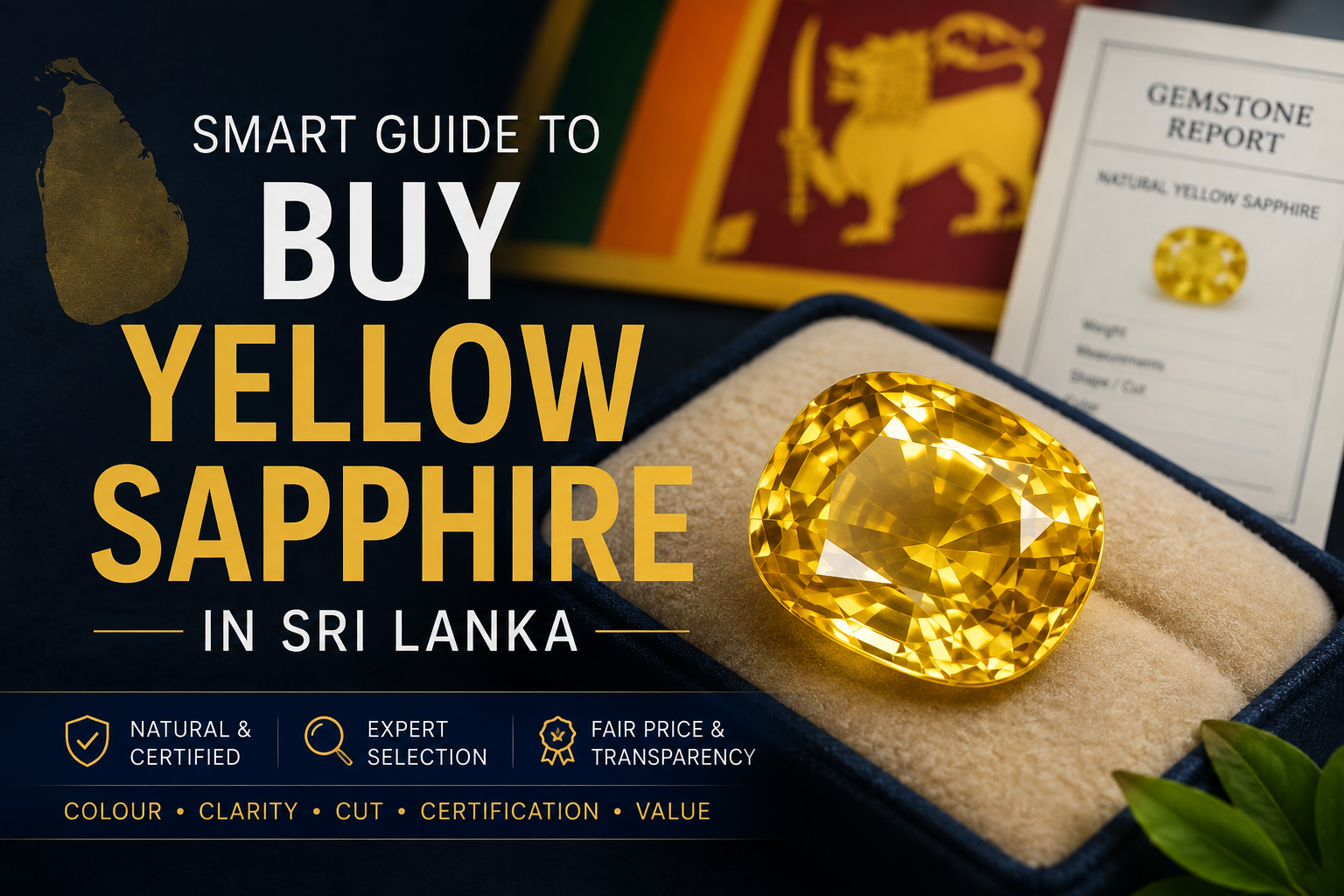
If you want to Buy yellow sapphire in Sri Lanka, the biggest challenge is not simply finding a bright yellow gemstone. It is knowing exactly what you are paying for. Natural origin, colour quality, treatment, cut, clarity, carat weight, laboratory documentation and seller transparency can all influence a sapphire’s desirability and value.
Sri Lanka has a centuries-old connection with gemstones, and yellow sapphire is among the corundum varieties found on the island. The National Gem and Jewellery Authority (NGJA) specifically lists yellow sapphire among gemstones occurring in Sri Lanka.
However, a beautiful stone should never be judged by colour alone. Treatments can change a sapphire’s appearance, while differences in cut and transparency can greatly affect how lively it looks. Therefore, this guide focuses on practical checks a Sri Lankan buyer can understand and verify before committing money.
Table of Contents
- What does it mean to buy yellow sapphire?
- Why Sri Lanka matters for yellow sapphires
- What exactly is a yellow sapphire?
- Natural, heated and diffusion-treated yellow sapphire
- How to evaluate yellow sapphire colour
- Clarity and inclusions
- Why cut quality matters
- Carat weight and dimensions
- Certification and laboratory reports in Sri Lanka
- How to buy yellow sapphire safely
- Yellow sapphire quality comparison table
- How yellow sapphire prices are determined
- Buying yellow sapphire for jewellery
- Buying yellow sapphire for astrological purposes
- Common mistakes Sri Lankan buyers should avoid
- People Also Ask
- Expert Q&A
- Final buying advice
Featured Answer: What Should You Check Before You Buy Yellow Sapphire?
To Buy yellow sapphire confidently, check whether the stone is natural, identify any treatment, evaluate its colour, clarity and cut, confirm its carat weight, and request a reputable laboratory report. In Sri Lanka, buyers can also use NGJA gemstone-testing and certificate-verification services for additional assurance before making a major purchase.
Why Sri Lanka Matters When You Buy Yellow Sapphire
Sri Lanka has an unusually strong relationship with coloured gemstones. The country is known internationally for sapphire, while areas such as Ratnapura have long been associated with gem mining and trading.
The local geological environment has produced numerous gemstone varieties. According to the NGJA, around 75 gemstone varieties have been mined or found in Sri Lanka. Yellow sapphire is specifically included in its list of gemstones found locally.
This local history creates an important advantage for buyers: expertise in mining, sorting, cutting, dealing and gemstone identification is widely available.
At the same time, Sri Lanka’s reputation should not replace proper due diligence.
A gemstone being offered in Colombo, Ratnapura, Beruwala, Kandy or elsewhere in Sri Lanka does not automatically prove that it is natural, untreated or Sri Lankan in origin. Origin conclusions normally require specialist gemological examination, and even then they may depend on whether enough diagnostic evidence is present.
Therefore, buy the individual gemstone on its documented characteristics rather than buying solely because the seller describes it as “Ceylon sapphire.”
What Is a Yellow Sapphire?
Yellow sapphire is the yellow variety of corundum, the same mineral family that includes blue sapphire and ruby.
Corundum is valued partly because it is highly durable. This makes properly cut sapphire suitable for rings, pendants, earrings and other jewellery intended for regular use.
However, the term “yellow sapphire” covers a wide range of appearances.
You may encounter stones that are:
- light lemon yellow;
- medium yellow;
- golden yellow;
- slightly greenish yellow;
- slightly orange-yellow;
- highly saturated vivid yellow;
- pale or unevenly coloured.
There is no single “best” shade for every buyer.
For jewellery, personal preference matters considerably. Some buyers prefer a softer lemon colour, while others want a richer golden appearance.
For value comparisons, however, colour should be considered together with treatment, transparency, cut, size and laboratory findings.
Buy Yellow Sapphire: Natural Does Not Mean Untreated
One of the most important concepts to understand is the difference between natural and untreated.
A natural sapphire formed in nature.
Yet a natural sapphire may later be heated or subjected to another treatment to alter its appearance.
Therefore:
Natural does not automatically mean unheated.
This distinction matters when you Buy yellow sapphire because two natural stones of similar visible appearance can have different treatment histories and, consequently, different market positions.
GIA explains that sapphires on the market may be treated by heat or lattice diffusion to modify their colour. It also advises obtaining a laboratory report when treatment is uncertain.
For a technical overview, the GIA sapphire buyer’s guide is a useful independent reference.
Natural, Heated and Diffusion-Treated Yellow Sapphire
Understanding these categories helps you compare offers more accurately.
Natural Unheated Yellow Sapphire
An unheated natural yellow sapphire has no detectable evidence of heat treatment.
Fine examples may command a premium because attractive natural colour without heating can be less common.
However, “unheated” does not mean that the stone will automatically be beautiful.
An unheated sapphire can still have:
- poor colour;
- distracting inclusions;
- weak brilliance;
- an unattractive cut;
- undesirable zoning.
Therefore, never buy a weak stone simply because the word “unheated” appears in the sales description.
Heated Yellow Sapphire
Heating is a well-established gemstone treatment.
Depending on the sapphire and treatment conditions, heat can modify colour or improve its appearance.
GIA research confirms that naturally pale or weakly yellow sapphires can develop stronger yellow coloration through heat treatment. The science of yellow colour in sapphire can be complex, particularly in low-iron material such as some Sri Lankan yellow sapphires.
A heated natural sapphire can still be an attractive and desirable gemstone.
The key issue is disclosure.
You should know what you are buying and compare its price with stones in the same treatment category.
Lattice-Diffusion or Diffusion-Treated Sapphire
Diffusion is different from conventional heating.
GIA notes that lattice diffusion uses high temperatures together with chemical elements to alter a sapphire’s colour. Diffusion-treated stones can display vivid colour, but GIA indicates that they are generally less valuable than comparable conventionally heated sapphires.
Consequently, treatment terminology should appear clearly on the seller’s documentation.
International jewellery-sector standards also emphasise treatment disclosure. The World Jewellery Confederation’s CIBJO Blue Books provide internationally recognised nomenclature and disclosure guidance for gemstones and jewellery.
Why Colour Matters When You Buy Yellow Sapphire
Colour is often the first feature a buyer notices.
Nevertheless, judging yellow sapphire colour requires more than asking whether the stone is “dark” or “light.”
Consider three basic aspects.
1. Hue
Hue is the basic colour you see.
For yellow sapphire, the dominant hue should naturally be yellow, although secondary green or orange components may sometimes be visible.
Your preference matters here.
A slightly golden yellow may appeal to one person, while another may prefer a clean lemon-yellow stone.
2. Tone
Tone describes how light or dark the colour appears.
If the stone is too light, it may look washed out.
If it is too dark, it can lose brightness.
A balanced tone often produces a more attractive face-up appearance.
3. Saturation
Saturation describes the strength or intensity of the colour.
A strong, attractive yellow often looks more appealing than a weak or greyish colour, assuming other quality factors are comparable.
However, extremely intense colour should not be treated as automatic proof of superior natural quality. Treatments can change colour, which is another reason laboratory evidence matters.
Check Yellow Sapphire in Different Lighting
Before purchasing a major gemstone, view it under more than one lighting condition whenever practical.
For example, compare it:
- in indirect daylight;
- under normal indoor lighting;
- against a neutral white background;
- face-up;
- from the side.
Why?
A sapphire may photograph beautifully under strong jewellery lighting yet appear darker or less saturated in ordinary conditions.
Likewise, highly edited photographs can give an unrealistic impression of saturation.
For an online purchase, therefore, ask for natural-looking video footage in addition to studio photographs when possible.
Also ask whether the images have been colour-adjusted.
Colour Stability Deserves Attention
Sri Lankan buyers should also be aware of colour stability.
In 2025, the NGJA publicly addressed concerns involving artificial irradiation and colour instability in sapphire varieties and rubies. The Authority said it was working with the industry on measures related to identifying treatment activity, disclosure and colour-stability testing.
This does not mean yellow sapphires in general are unstable.
Rather, it demonstrates why treatment disclosure and professional gemstone examination remain important.
When a stone has unusual treatment characteristics, ask the laboratory or seller whether there are relevant colour-stability considerations.
Clarity: Should Yellow Sapphire Be Completely Clean?
Not necessarily.
Natural gemstones can contain inclusions because they grow in geological environments rather than controlled factories.
These internal features may include:
- crystals;
- healed fissures;
- needles;
- fingerprints;
- zoning;
- other natural growth features.
Some inclusions can even help gemologists understand a gemstone’s natural origin or treatment history.
However, buyers usually prefer a stone that looks reasonably clean without magnification.
A practical approach is to ask:
Can I easily see the inclusion when looking at the stone normally?
If the answer is yes, decide whether its location affects beauty or durability.
For example, an inclusion near the edge could be more concerning than a small internal feature hidden under a facet.
Meanwhile, do not automatically trust claims such as “100% flawless.” Natural coloured stones are not graded using exactly the same system commonly associated with diamonds.
Why Cut Quality Matters When You Buy Yellow Sapphire
A gemstone may have excellent colour in the rough but still look disappointing after poor cutting.
Cut controls how light travels through the finished stone.
A good cutter tries to balance:
- brightness;
- colour;
- proportions;
- symmetry;
- finished carat weight;
- the shape of the original rough.
Poor cutting can produce a noticeable window.
A window is a transparent-looking central area through which you can appear to see straight through the gemstone rather than seeing light returned toward your eyes.
At the other extreme, an overly deep sapphire can hide weight underneath the setting without giving you a correspondingly larger visible appearance.
Therefore, when comparing two stones of identical carat weight, compare their millimetre dimensions as well.
GIA specifically notes that sapphire cut quality can make a major difference to beauty and brilliance.
Carat Weight Versus Visible Size
Carat is a measure of weight, not face-up dimensions.
One carat equals 0.2 grams.
However, two yellow sapphires weighing the same can look different in size.
Why?
One stone may have more weight hidden in its depth.
For that reason, ask for:
- carat weight;
- length;
- width;
- depth;
- shape.
Dimensions are normally recorded in millimetres.
This information becomes particularly important when choosing a stone for an existing jewellery design.
Yellow Sapphire Quality Comparison
| Factor | Better Buying Signal | Requires More Caution |
|---|---|---|
| Identity | Natural sapphire confirmed by a reputable lab | Identity based only on seller description |
| Treatment | Treatment clearly disclosed | Treatment information unavailable or vague |
| Colour | Attractive, even yellow in normal lighting | Heavy zoning, dull areas or unrealistic-looking photos |
| Cut | Good brilliance with limited windowing | Large window, very deep pavilion or uneven symmetry |
| Clarity | Attractive to the unaided eye | Large fractures or distracting central inclusions |
| Documentation | Report number and details can be checked | Unverifiable certificate |
| Seller information | Clear invoice, disclosures and return terms | Pressure to pay quickly without documents |
| Price | Explained using comparable quality factors | Extremely low price with extraordinary claims |
The table is a screening tool rather than a formal grading system.
No single row determines overall quality.
Instead, evaluate the gemstone as a complete package.
Certification When You Buy Yellow Sapphire in Sri Lanka
A laboratory report is particularly valuable when you are spending a significant amount.
A useful report may address questions such as:
- Is the stone natural or synthetic?
- What gemstone species or variety is it?
- Is there evidence of heat treatment?
- Is another detectable treatment present?
- What does the stone weigh?
- What are its dimensions?
- Does the laboratory provide additional comments?
In Sri Lanka, the NGJA operates gemstone testing and certification services and provides different types of gemstone reports.
The Authority also states that certificate authenticity can be checked online using a phone or computer.
You can review the NGJA Gem Testing Laboratory for current information on its testing services.
Remember that a laboratory report is not the same as a sales guarantee.
A report describes gemological findings. You still need to decide whether the gemstone’s beauty, condition and price suit you.
How to Buy Yellow Sapphire: 10-Point Checklist
Use this process before making your final payment.
- Confirm gemstone identity.
Ask whether it is natural sapphire, synthetic sapphire or another material. - Ask about every known treatment.
Do not settle for simply hearing “natural.” Ask specifically whether it is heated, diffusion treated or otherwise modified. - Request the laboratory report.
For higher-value purchases, independent documentation gives you more information than a seller’s verbal description alone. - Verify the report where possible.
Check its number and details through the issuing laboratory’s official verification system. - Compare the stone with its report.
Weight, measurements and identifying information should be consistent. - Judge colour in realistic light.
Do not depend entirely on heavily illuminated showroom conditions. - Inspect the cut face-up.
Look for dull zones, windows, uneven brilliance or an unattractive outline. - Check clarity and condition.
Ask about significant fractures, chips, surface-reaching inclusions or damage. - Get the sale terms in writing.
Keep the invoice, gemstone description, treatment disclosure, price and applicable return conditions. - Compare like with like.
An unheated natural sapphire should not be compared purely on price with a diffusion-treated stone of similar visible colour.
Following this checklist slows the buying process slightly. However, that is often an advantage when purchasing something valuable.
How Is Yellow Sapphire Price Determined?
There is no trustworthy universal “yellow sapphire price per carat.”
Several variables interact.
Colour
Colour attractiveness can strongly influence demand.
An appealing, well-saturated yellow with even distribution may command more than a pale or unevenly coloured stone, all else being equal.
Treatment
Treatment history can significantly affect market positioning.
A fine unheated sapphire may be priced differently from a conventionally heated example.
Likewise, diffusion treatment needs to be considered separately.
Size
Larger fine-quality sapphires can become progressively more difficult to source.
Therefore, price does not necessarily increase in a perfectly straight line with carat weight.
Clarity
A transparent sapphire with few distracting inclusions may be more desirable than a heavily included example.
However, coloured gemstones should not be evaluated by simply applying diamond clarity expectations.
Cut
A well-cut stone may display stronger brilliance and a more attractive visible size.
Conversely, poor proportions can reduce appeal even when the rough material was good.
Origin
A respected laboratory may sometimes provide a geographic-origin opinion when sufficient evidence is available.
However, origin should never replace assessment of the gemstone itself.
A poor-quality stone does not become excellent merely because a famous geographic name appears beside it.
Documentation
Reliable laboratory documentation can increase buyer confidence because important claims become independently testable.
For this reason, compare documented stones with similarly documented stones when judging price.
Should You Buy the Cheapest Yellow Sapphire?
Usually, price should be assessed together with specification.
Suppose you find three apparently similar 3-carat yellow sapphires.
One is substantially cheaper.
That does not necessarily make it a bargain.
Possible differences might involve:
- treatment;
- synthetic versus natural origin;
- colour quality;
- clarity;
- cutting;
- certification;
- damage;
- return policy;
- undocumented claims.
Likewise, the most expensive stone is not automatically the best.
A sensible buyer asks:
What measurable or documented quality difference explains this price?
If the seller cannot answer clearly, obtain more information before buying.
Buy Yellow Sapphire Online or In Person?
Both methods can work.
Buying In Person
Advantages include the ability to inspect colour and brilliance directly.
You may also find it easier to compare several stones side by side.
Nevertheless, showroom lighting can influence appearance. Therefore, request to see the stone in neutral conditions where practical.
Buying Online
Online shopping gives you access to a larger selection.
However, you should request enough information to evaluate the exact gemstone being offered.
Useful information includes:
- actual gemstone photos;
- video;
- carat weight;
- millimetre dimensions;
- treatment disclosure;
- lab-report details;
- return conditions;
- final payable price.
Avoid relying solely on a highly processed photograph.
Loose Yellow Sapphire or Finished Jewellery?
Buying a loose gemstone gives you greater freedom to examine the stone.
You can inspect:
- the pavilion;
- girdle;
- inclusions;
- dimensions;
- possible chips;
- overall symmetry.
Once a gemstone is mounted, some areas become hidden by the setting.
Therefore, if the gemstone itself represents a major part of the purchase value, reviewing it loose before setting can be helpful.
On the other hand, finished jewellery is convenient for buyers who want an immediately wearable piece.
In that case, request documentation for both the gemstone and the relevant precious metal specification.
Choosing Yellow Sapphire Jewellery in Sri Lanka
Yellow sapphire works with several jewellery metals.
Common choices include:
- yellow gold;
- white gold;
- platinum;
- mixed-metal designs.
The best option depends on appearance, budget and intended use.
Yellow gold can complement warmer yellow tones, while white metals can create stronger visual contrast.
For rings, also consider protection.
Sapphire is durable, but no gemstone is impossible to chip. A secure setting becomes especially important for daily-wear rings.
If the stone has vulnerable corners or inclusions close to an exposed edge, discuss setting design with an experienced jeweller.
Buying Yellow Sapphire for Astrology
A meaningful portion of yellow sapphire demand in South Asia is connected with Vedic astrological traditions, in which yellow sapphire may be associated with Jupiter or “Guru.”
However, it is important to separate cultural or religious belief from gemological fact.
Gemology can establish properties such as:
- gemstone identity;
- natural or synthetic origin;
- detectable treatment;
- weight;
- measurements;
- certain physical and optical characteristics.
Gemological laboratories do not scientifically certify that a gemstone will create wealth, improve marriage prospects, cure illness or guarantee good fortune.
Therefore, if you want to Buy yellow sapphire for an astrological purpose, you can follow your preferred cultural tradition while still applying normal gemstone-buying safeguards.
For example, if an astrologer recommends a particular weight, you can then ask a qualified gem professional to help you find a documented natural sapphire meeting that specification.
Avoid sellers who use guaranteed medical, financial or life-changing results as a substitute for gemstone evidence.
“Ceylon Yellow Sapphire”: What Does the Name Mean?
“Ceylon” is the former English name of Sri Lanka and remains widely used in the international gemstone trade in descriptions such as “Ceylon sapphire.”
However, a commercial phrase is not laboratory proof of geographic origin.
If Sri Lankan origin materially affects your purchase decision, ask whether the claim is supported by an independent gemological report capable of giving an origin opinion.
Additionally, check exactly what the document says.
“Purchased in Sri Lanka” and “origin: Sri Lanka” are not equivalent statements.
Certificate Versus Appraisal Versus Invoice
These documents serve different purposes.
Gemological Report
A gemological report records laboratory findings concerning the gemstone.
Valuation or Appraisal
An appraisal gives an opinion relating to value for a stated purpose and date.
The valuation figure should not automatically be interpreted as the price at which you could immediately resell the stone.
Sales Invoice
The invoice records the commercial transaction.
Ideally, it should describe the gemstone clearly enough to identify what was sold.
Keep all three documents when they are available.
Common Mistakes When You Buy Yellow Sapphire
Mistake 1: Buying Only by Carat Weight
A larger gemstone can still have weak colour or poor cutting.
Beauty per carat matters more than weight alone.
Mistake 2: Assuming “Natural” Means “Unheated”
It does not.
Always ask about treatment separately.
Mistake 3: Trusting Colour as Proof of Quality
Bright colour can occur in stones with different treatment histories.
A professional report provides far more useful information.
Mistake 4: Paying a Premium for “Ceylon” Without Evidence
Sri Lanka is globally associated with fine sapphires, but geographic-origin claims should be supported where they materially influence the price.
Mistake 5: Ignoring the Cut
A poor cut can reduce brilliance and visible size.
Look at the gemstone itself rather than concentrating only on its certificate.
Mistake 6: Comparing Different Treatment Categories
Compare an unheated stone with other unheated stones of similar size and quality.
Likewise, compare heated stones with comparable heated material.
Mistake 7: Believing a Certificate Makes the Price Fair
A laboratory report helps establish gemological facts.
It does not decide whether the seller’s asking price represents good value.
You still need comparison shopping.
Mistake 8: Accepting Extraordinary Claims Without Evidence
Terms such as “museum quality,” “investment grade,” “perfect,” or “extremely rare” can be subjective marketing language.
Ask for measurable information instead.
People Also Ask About Buying Yellow Sapphire in Sri Lanka
Is Sri Lanka a good place to buy yellow sapphire?
Sri Lanka has a long-established gemstone industry and is a known source of yellow sapphire. However, buyers should still verify gemstone identity, treatments, documentation and seller terms rather than relying only on the country’s reputation.
How can I know if a yellow sapphire is natural?
Visual inspection alone is not always enough. For a valuable gemstone, request a report from a recognised gemological laboratory confirming whether it is a natural sapphire and reporting detectable treatments.
Is heated yellow sapphire worth buying?
Yes, a properly disclosed heated natural sapphire can be an attractive gemstone. The important point is that treatment should be known, documented where appropriate and reflected when comparing prices with unheated or differently treated stones.
Which yellow sapphire colour is best?
There is no universally perfect shade. Many buyers favour lively, evenly distributed yellow with good saturation, but personal preference, treatment status, clarity and cut must also be considered.
Should yellow sapphire have a certificate?
For a significant purchase, an independent laboratory report is highly advisable. It can help confirm gemstone identity and provide important treatment information that cannot always be determined by a consumer’s visual inspection.
Expert Q&A About Yellow Sapphire
1. Can two yellow sapphires with the same carat weight have very different prices?
Absolutely. Colour, treatment, transparency, clarity, cutting quality, dimensions, documentation and sometimes origin can differ substantially. Therefore, identical carat weight tells you very little about whether two stones should have the same price.
2. Why does a yellow sapphire sometimes look bigger than another stone of the same weight?
Carat measures weight rather than visible diameter. A deep stone may carry considerable weight below the girdle, while a better-proportioned gemstone may present more surface area when viewed face-up.
3. Can a jeweller tell whether every yellow sapphire has been heated just by looking at it?
Not reliably in every case. GIA research shows that determining treatment in some low-iron yellow sapphires can be challenging and may involve inclusion examination together with advanced analytical techniques such as spectroscopy.
4. Does an unheated yellow sapphire always cost more?
Not automatically. Treatment status is only one value factor. An unattractive unheated sapphire may reasonably be worth less than a beautiful heated sapphire with superior colour, transparency and cut. Compare stones as complete gemstones rather than ranking them by a single label.
5. What records should I keep after buying a yellow sapphire?
Keep your invoice, laboratory report, report-verification information, photographs, gemstone measurements and any written treatment disclosure. If the stone is later mounted into jewellery, keep the jewellery invoice and relevant precious-metal documentation as well.
Final Thoughts: Buy Yellow Sapphire With Evidence, Not Hype
The safest way to Buy yellow sapphire is to combine personal preference with verifiable information.
Start with colour. The gemstone should genuinely appeal to you.
Then go deeper.
Confirm whether the stone is natural. Ask about treatment. Examine the cut, clarity, dimensions and visible condition. For a significant purchase, obtain a recognised laboratory report and verify the document where possible.
Sri Lanka gives buyers access to a remarkably established gemstone ecosystem, from Ratnapura’s historic gem trade to laboratories and experienced cutters and jewellers. Still, the strongest purchase is one supported by transparent documentation rather than reputation alone.
Most importantly, compare equivalent gemstones. An unheated natural sapphire, a heated natural sapphire and a diffusion-treated sapphire should not be treated as interchangeable products merely because all three look yellow.
When you understand those differences, you are in a much better position to judge beauty, suitability and value for yourself.
If you are ready to compare natural yellow sapphires for your jewellery or personal requirements, explore the Prestige Gems Store selection of carefully presented gemstones and review each stone’s individual characteristics before choosing the one that suits you.
 Blue Sapphire
 Pink Sapphire
 Yellow Sapphire
 Padparadscha Sapphire
 White Sapphire
 More
More Amethyst
 Peridot
 Moonstone
 Garnet
 Aquamarine
 Spinel
 Ladies Rings
 Pendants
 Earrings
 Gent’s rings